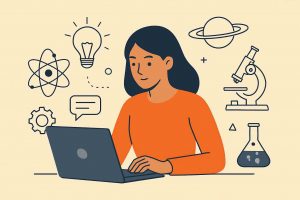
In today’s world, science and technology are not merely fields of interest—they are the language of the future, the driving force behind innovation, and the foundation of societal transformation. From artificial intelligence to space exploration, biotechnology to climate science, young people are standing at the edge of an endless universe of discovery.
But how can they navigate this vast landscape in a truly meaningful and effective way?
This is where Kolb’s Experiential Learning Theory becomes a powerful compass.
1. Learning Is a Process, Not a Result
According to Kolb, learning gains its true value not from outcomes written on paper but from engagement with the process itself.
This idea is essential for young people who aspire to excel in science and technology. After all, scientific progress is built on cycles of trying, failing, rethinking, and trying again.
When you build a robot, develop software, or prepare for a science fair, every step—no matter how small—is part of your unique learning journey.
2. All Learning Is Re-Learning
One of the most transformative ideas Kolb presents is that learning begins when individuals reveal their existing beliefs and test them against new experiences.
For young innovators, this means constantly questioning assumptions.
Instead of saying “I already know this,” ask:
“How else can I approach this?”
This mindset forms the core of creativity and scientific growth.
As Piaget emphasized, knowledge is not delivered as a finished product—it is constructed through experience.
3. Conflict Drives Learning
Every new scientific or technological project comes with obstacles: conflicting ideas, unexpected results, disagreements…
Kolb argues that these tensions are not barriers but the engines of learning.
When you debug a stubborn piece of code, troubleshoot a failing circuit, or analyze why a chemistry experiment didn’t go as planned—those moments carry the highest learning potential.
Young people who learn to embrace these challenges instead of avoiding them gain the resilience that innovation requires.
4. Learning Is a Holistic Process
Science and technology are not purely intellectual pursuits. They engage the whole person—thinking, feeling, observing, experimenting, and acting.
A scientist is not only someone who thinks but someone who senses, questions, builds, and transforms.
Maker spaces, science workshops, coding camps, and robotics clubs are all modern reflections of this holistic learning process.
5. Learning Emerges Through Interaction With the Environment
Kolb describes learning as a synergistic interaction between the individual and their environment.
This means your growth is shaped not only by your effort but also by the communities and experiences around you.
Participating in science fairs, joining technology competitions, volunteering in laboratories, or working on projects at a science center—all these experiences turn knowledge into something you can touch, test, and live.
6. Learning Is a Process of Creating Knowledge
In experiential learning, knowledge is not a fixed package handed from teacher to student.
It is something each learner creates through their own experiences.
For a young person developing software or building a drone, the goal is not just technical skill—it is the creation of a new way of thinking and solving problems.
Science and technology, therefore, offer not only careers but also the opportunity to design your own understanding of the world.
A Roadmap for Young Innovators
Kolb’s theory reminds us of a simple but powerful truth:
Learning is not passive—it is an active process of creating, reshaping, and engaging.
Young people who want to excel in science and technology should keep four principles in mind:
🔹 Learn through experience.
🔹 Do not fear mistakes.
🔹 Question your assumptions.
🔹 Interact with your environment and community.
The future will belong not to those who merely consume knowledge, but to those who create it anew.
And this journey begins with small, bold steps powered by personal experience and curiosity.